Best Folding Squat Rack: Wall Mounted Racks Compared
The Titan T-3 wall mounted folding power rack ($417.99) is the best folding squat rack for most garages: 2x3 eleven gauge uprights on a hinge, folding to about 5 inches of wall depth, and needing about 7 feet 4 inches of clear ceiling for its 82 inch height. Its anchors carry the entire load, so the wall behind it matters more than the tube in front of it.
A folding rack is the only rack that gives a garage back to the car, and the thing worth understanding before you shop is that you are not really buying the rack, you are buying the wall. The Titan T-3 folding power rack at $417.99 is the best of the three below, and it is only as good as what you bolt it into.
Below are three folding racks at real price separations, plus the five numbers that decide whether one works in your space: what is behind your wall, folded depth, the swing arc, mounting height against your ceiling, and rated capacity.
Best folding wall mounted squat racks by tier
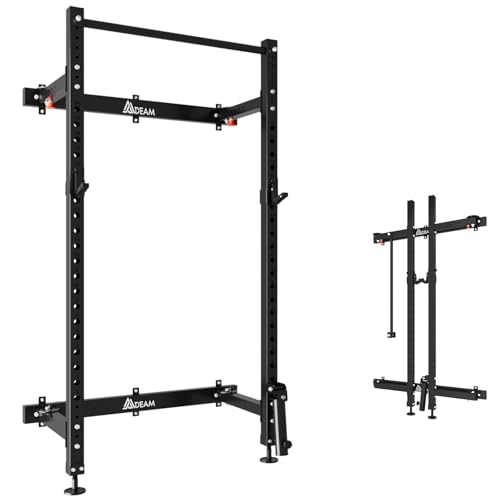
Mdeam Folding Squat Rack, 2.36 inch Wall Mounted Power Rack
The lowest price at which a folding wall rack is a real rack rather than a novelty. It still has to be lagged into studs or masonry, and the anchors are the load path, so the wall behind it matters more than the tube in front of it.
Best for: A single-bay garage where the rack has to disappear before the car comes in.
Check price
Mikolo Folding Wall Mounted Squat Rack
Rated to 1,000 lb and folds to roughly 5 inches of wall depth, so the car still fits and the ping pong table still opens. The catch is that it needs solid stud or masonry backing, which is a build decision, not a shopping decision.
Best for: A garage that has to stay a garage between sessions.
Check price
Titan Fitness T-3 Series Wall Mounted Folding Power Rack, 82 inch
2x3 eleven gauge uprights on a hinge, so you get a real rack when it is open and a wall when it is closed. It bolts into studs or concrete, and the 82 inch height needs about 7 feet 4 inches of clear ceiling.
Best for: A garage with at least 7 feet 6 inches of ceiling and studs you can actually find.
Check pricePrices change often, confirm on Amazon. As an Amazon Associate we earn from qualifying purchases.
What is behind your wall, and does it take a rack?
A folding rack is anchored through two mounting plates into the structure behind the wall finish, and that structure is the load path for everything you lift. Four scenarios cover almost every garage.
Wood studs at 16 inches on center. The common case and the easiest one. Most folding rack mounting plates are drilled so the hole pattern lands on studs at that spacing, and lag screws into the center of solid framing are what the manufacturer designed for. Confirm the spacing across the whole plate width, not at one end.
Wood studs at 24 inches on center. Common in newer construction and in some garages. Check the rack's hole pattern before you buy, because a plate drilled for 16 inch spacing may only catch framing at one point. The usual fix is a horizontal backing board, a 2x member lagged across several studs, which spreads the load and gives you material to anchor into.
Concrete or CMU block. Strong, but different hardware. Wedge or sleeve anchors rather than lag screws, drilled with an SDS-Plus rotary hammer, and in hollow block you must hit the solid web rather than the void. Embedment depth, not bolt length, is what carries the load.
Furring strips over masonry, or a finished garage of unknown construction. Do not guess. Furring strips are fastened for drywall, not for a rack, and a thin strip will pull out under a failed squat. Open a small inspection hole or hire someone to tell you what is there. Our anchoring a rack safely guide walks through the fastener choices in more detail.
How much space does a folded rack really save?
Folded depth on the racks here is roughly 5 inches, so a folded rack occupies about the depth of a shallow bookshelf against the wall. That is the number that sells the category, and it is real.
The number people forget is the swing arc. The uprights pivot on a hinge at the wall, which means the full open depth of the rack has to be clear as an arc, not just as a rectangle. If the open rack sits 21 inches from the wall, you need 21 inches of clear floor swept along the full upright height every time you open it, so a shelf, a bike hanging on the wall or a chest freezer within that arc makes the rack unusable rather than merely inconvenient.
Then add the lifting area on top of the open footprint. A 7 foot barbell is 86.6 inches long, so any rack you squat and press in needs at least 9 feet of clear width regardless of how narrow the rack itself folds. Folding solves the parked-car problem, not the barbell-length problem.
| Rack | Price | Rated capacity | Folded depth | Height | Upright |
|---|---|---|---|---|---|
| Mdeam folding squat rack | $159.99 | Manufacturer rated | 2.36 in | Not stated | Wall mounted |
| Mikolo folding wall rack | $279.99 | 1,000 lb | About 5 in | Not stated | Wall mounted |
| Titan T-3 folding power rack | $417.99 | Manufacturer rated | About 5 in | 82 in | 2x3, 11 gauge |
How high should a folding rack be mounted?
Mounting height is a decision, not a given, and it is one of the few advantages a wall rack has over a free standing one. You choose where the top of the frame lands.
The 82 inch Titan T-3 needs about 7 feet 4 inches of clear ceiling: the rack height plus roughly 2 inches of clearance, plus room to swing the frame up during assembly. Measure to the lowest obstruction, which in a garage is almost always the garage door track or the opener rail rather than the ceiling itself. That is the measurement that kills more folding rack installs than any other.
Two more heights matter. J-cup range has to cover both your squat rack position and your bench press position, so check that the hole pattern extends low enough for benching once the rack is mounted where the ceiling allows. And if you intend to do pull-ups on the crossmember, you need roughly your height times 1.18 plus about 9 inches of head travel, which is a much taller requirement than the rack itself. Run your own numbers through the ceiling height calculator before you drill.
What does rated capacity mean on a folding rack?
A stated rating like the Mikolo's 1,000 lb describes the frame under the manufacturer's test conditions, correctly installed. It is not a rating of your wall. A 1,000 lb frame lagged into one stud is not a 1,000 lb rack, it is a 1,000 lb frame attached to whatever that single lag screw can hold.
Practically, the steel is rarely the limit at home gym loads. The Titan uses 2x3 eleven gauge tube, the same specification found on mainstream free standing racks, and eleven gauge is thicker steel than the 14 or 12 gauge used on budget 2x2 frames. What separates the $159.99 rack from the $417.99 one is tube size, hole spacing, hardware size and attachment ecosystem rather than a number you will reach.
The downside nobody mentions: it does not move
A free standing rack can be dragged into a different corner when you rearrange, loaned to a friend, or loaded into a truck when you move. A folding rack cannot. Once it is mounted, moving it means unbolting it, patching a grid of holes in framing or masonry, and finding equally suitable structure in the new spot.
That has three practical consequences. Renters need permission before drilling and should assume they are patching the wall on the way out. Anyone unsure about their layout should plan the whole room before mounting, because the rack position then fixes where the bench, the platform and the plate storage go. And resale value is lower than an equivalent free standing rack, because the buyer inherits the same wall problem you had.
If any of that bothers you, our folding rack vs free standing rack comparison lays the two out side by side.
Who should not buy the Expert tier?
Plenty of people should not spend $417.99 on the Titan T-3, and the cases are easy to name. If you squat under about 275 lb, bench under about 225 lb, and you are mounting to well spaced wood studs in a single bay garage, the Mikolo at $279.99 is rated to 1,000 lb and folds to the same 5 inches of wall depth. The $138 difference buys you tube size and an attachment ecosystem, not safety margin you are using.
If your ceiling is under about 7 feet 4 inches to the lowest obstruction, the 82 inch Titan is the wrong purchase at any budget, and you should be reading our low ceiling rack guide instead. And if you are building a first gym on a total budget under about $800, where the bar and the plates still have to come out of the same money, the $159.99 Mdeam rack is a real rack and the $258 you save buys a genuine Olympic barbell. Buy the T-3 when you already know the wall is good, the ceiling clears it, and you intend to keep adding to the rack.
Related reading
- Anchoring a rack safely: fasteners, embedment and what not to drill into
- Best squat rack for low ceilings: when 82 inches is too tall
- Rack height clearance chart: every rack style against a ceiling
- All gear reviews
Frequently asked questions
What is the best folding squat rack?
The Titan T-3 wall mounted folding power rack at $417.99 is the best folding rack for most garages. It uses 2x3 eleven gauge uprights on a hinge, so it behaves like a real rack when open and disappears to wall depth when closed. At 82 inches tall it needs about 7 feet 4 inches of clear ceiling. On a smaller budget the Mikolo folding rack at $279.99 is rated to 1,000 lb.
How much wall depth does a folding rack take up when folded?
About 5 inches on the racks in this guide, which is roughly the depth of a shallow shelf. That is the entire point of the category: a car still fits in the bay, a ping pong table still opens, and the rack is not something you walk around for the other 165 hours of the week. The uprights fold flat against the wall and the pull-up bar or crossmember stays fixed.
Can I mount a folding rack into drywall or a single stud?
No. A folding rack transfers every pound you lift into its anchors, so the wall is the load path and drywall carries none of it. You need to hit real framing across the full width of the mounting plates, or solid masonry with the correct anchors. Catching one stud at the edge of a plate is a failure mode, not a compromise. If you cannot verify what is behind the wall, buy a free standing rack instead.
What ceiling height does a folding wall rack need?
An 82 inch rack wants about 7 feet 4 inches of clear ceiling, which is the rack height plus roughly 2 inches of clearance and room to tilt the frame during assembly. Measure to the lowest obstruction, meaning the garage door track, the opener rail, a duct or a light fixture, not the drywall. Pull-ups on the crossmember need considerably more, roughly your height times 1.18 plus about 9 inches of head travel.
Can a folding rack be moved after it is mounted?
Not without patching the wall and re-anchoring, and that is the honest downside of the category. A free standing rack can be dragged to a new corner or taken to a new house. A folding rack leaves a grid of lag holes or anchor holes in framing or masonry and has to be re-mounted somewhere with equally suitable structure. Renters in particular should get permission before drilling.
Is a folding rack as strong as a free standing power rack?
The steel usually is, and the anchors decide the rest. The Titan T-3 folding rack uses the same 2x3 eleven gauge tube found on mainstream free standing racks, and the Mikolo is rated to 1,000 lb. What changes is where the load goes: a free standing cage resists tipping with its own footprint, while a folding rack resists it entirely through the wall connection. That makes the install quality the real variable.
How we choose: we compare published manufacturer specifications, stated load ratings, and verified owner reviews. We do not test equipment in person. Rack anchoring, floor loading and spotting carry real injury and property risk, so treat everything here as researched guidance rather than coaching or structural engineering advice, follow the manufacturer's rated capacity and installation instructions, and get a licensed professional involved before you drill into concrete or load a floor you are unsure about.