Best Home Gym Flooring in 2026
Three quarter inch rubber stall mats ($119.99 for a 4 by 6 ft mat, about 100 lb each) are the best home gym flooring for most builds. Two mats cover 48 square feet, enough for a rack footprint plus a lifting area. Half inch EVA foam ($49.99) is bodyweight and dumbbell only, and it compresses permanently under rack feet.
Flooring is the cheapest part of a home gym build to get right and one of the most expensive to get wrong, because the mistake shows up in a cracked slab or a dented subfloor rather than on a receipt. The default answer for a garage or basement is the 3/4 inch rubber stall mat at $119.99 per 4 by 6 foot mat , which stays put by its own weight and absorbs a dropped bar without any fastening at all.
Gym flooring thickness is a drop protection specification, not a comfort specification. Everything soft enough to feel plush underfoot is too soft to sit a rack on, and everything thick enough to take a dropped barbell feels firm to stand on. Pick for the load, not the feel.
Best home gym flooring by situation
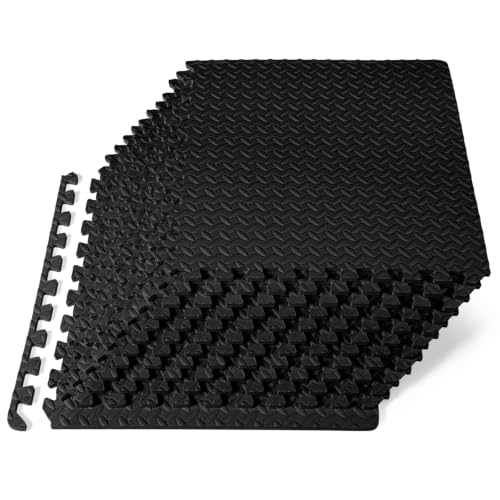
ProsourceFit Exercise Puzzle Mat, half inch EVA Foam Tiles
Cheap, warm underfoot and easy to cut around a rack base. Foam is for bodyweight work and dumbbells only. It compresses permanently under rack feet and it will not protect a slab from a dropped barbell.
Best for: A dumbbell and bodyweight corner, or an underlayer beneath rubber.
Check price
Heavy Duty Rubber Stall Mat, 4 by 6 ft, three quarter inch
The garage gym default for a reason. Three quarter inch recycled rubber at roughly 100 lb a mat absorbs a dropped bar, stays put by weight alone and outlasts the rack on top of it. Two mats cover a standard rack footprint.
Best for: Any platform, rack base or deadlift area over concrete.
Check price
Flooring Inc quarter inch Tough Rubber Flooring Roll
Rolls give you a seamless floor with no tile joints to catch a plate edge, and they are the cheapest way to cover a whole room per square foot. Quarter inch is a traffic and equipment surface, so add stall mats under the drop zone.
Best for: Covering an entire basement or garage bay wall to wall.
Check pricePrices change often, confirm on Amazon. As an Amazon Associate we earn from qualifying purchases.
What thickness do I actually need?
Four tiers cover the whole market, and each one is defined by what it can take without failing.
Half inch EVA foam, sold as the ProsourceFit puzzle mat at $49.99 , is for bodyweight work and dumbbells, full stop. It is cheap, warm underfoot, easy to cut around a rack base and completely unsuitable as a rack surface, because rack feet concentrate the load on four small areas and foam takes a permanent set under them within weeks. It also will not protect a slab from a dropped barbell. Its honest jobs are a dumbbell corner, a stretching area, or an underlayer beneath rubber.
Three quarter inch rubber stall mat, the 4 by 6 foot mat at $119.99 , is the garage gym default and the one to buy if you buy one thing. At roughly 100 lb per mat it does not need adhesive or tape, it just stays where you put it. Recycled rubber at this thickness absorbs a dropped bar over concrete and lasts longer than the rack standing on it.
Quarter inch rubber roll, sold here as the Flooring Inc tough rubber roll at $149.94 , is a traffic and equipment surface rather than a drop surface, and it is the cheapest way to cover a whole room per square foot. Rolls also give you a seamless floor with no tile joints for a plate edge to catch. Cover the room in roll, then add stall mats in the drop zone.
One inch rubber tile, such as the SUPERJARE extra-thick mat at $189.99 , is the top of the drop protection and impact noise tier. It is the thickness that matters over a wood subfloor with a finished room below, where the goal is not just protecting the floor but keeping the noise out of the rest of the house.
| Flooring | Thickness | Price | Weight added | Rack feet | Dropped barbell |
|---|---|---|---|---|---|
| EVA foam tiles | 1/2 in | $49.99 | ~0.3 lb/sq ft | No, compresses permanently | No |
| Rubber roll | 1/4 in | $149.94 | ~1.5 lb/sq ft | Yes, with plywood | Not on its own |
| Rubber stall mat | 3/4 in | $119.99 per mat | ~4 lb/sq ft | Yes | Yes, over concrete |
| Rubber tile | 1 in | Varies | ~5 lb/sq ft | Yes | Yes, best impact noise |
How much flooring do I need?
Start from the rack and work outward. A standard power rack footprint is roughly 4 feet wide by 4 feet deep once you allow for the base, and you want a lifting area in front of it for walkouts, deadlifts and a bench.
Two 4 by 6 foot stall mats give you 48 square feet, laid as an 8 by 6 foot rectangle. That covers the rack footprint plus a lifting area and is the single most common correct answer in this niche. Three mats gets you 72 square feet and room for a bench station beside the rack. A full two car garage bay is closer to 200 square feet, which is roll territory with mats laid over the drop zone. Run your own room through the flooring square footage calculator rather than guessing, because rubber is expensive to buy twice.
Plan the seams before you cut anything. Seams belong outside the drop zone, not under it, because a plate landing on a joint is what makes mats creep apart over time.
What goes under a rack foot, and what goes under the drop zone?
A rack foot is a static point load and a drop zone is an impact load, and they are two different problems that happen to be solved with the same material. Treating a gym floor as one uniform surface is the reason people buy the wrong thing twice.
Under a rack foot, the number that matters is pressure rather than energy. A power rack base plate is commonly around 2 by 4 inches per foot, so four feet give you roughly 32 square inches of contact. Put a 100 lb rack on that with 300 lb of plates stored on the uprights and you are delivering something in the region of 12 lb per square inch continuously, every hour of every day, for years. Rubber shrugs at that. Foam does not: EVA takes a permanent set under a sustained point load within weeks, and once the rack has sunk into it, the uprights are no longer sitting level and the mat is no longer protecting anything.
Under a drop zone the problem inverts. The pressure is briefly enormous and the duration is milliseconds, so what you need is mass and thickness to absorb energy before it reaches the slab. That is why three quarter inch rubber is the floor of the category here and one inch is the tier above it, and why a quarter inch roll on its own is not a drop surface no matter how good the rubber is.
The third zone is everything else: the walkway, the dumbbell corner, the space the bench lives in. That zone only needs to be comfortable and easy to clean, which is where cheap material genuinely belongs. Build the floor in zones and you spend the money where the load is.
| Zone | Type of load | Minimum spec | Typical area | What fails if you cheap out |
|---|---|---|---|---|
| Under rack feet | Sustained point load | 3/4 in rubber | 16 to 20 sq ft | Foam takes a permanent set, rack sits out of level |
| Barbell drop zone | Impact | 3/4 to 1 in rubber | 24 to 48 sq ft | Chipped slab, cracked plates, noise through the structure |
| Bench and dumbbell area | Moderate point load | 1/4 to 1/2 in | 20 to 40 sq ft | Dented subfloor from a dropped 50 lb dumbbell |
| Walkway and open floor | Foot traffic only | 1/4 in roll or foam | Balance of room | Little, this is where cheap material belongs |
| Under plate storage | Concentrated static load | 3/4 in rubber | 4 to 9 sq ft | Iron edges cutting into foam or bare finish |
What does gym flooring cost per square foot?
Cost per square foot is the only fair way to compare flooring, because the products are sold in completely different units: a single mat, a bundle of tiles, or a roll priced by length. Pack coverage varies between listings, so confirm the square footage on the listing you are actually buying rather than assuming the figures below.
A 4 by 6 foot stall mat covers 24 square feet, so at $119.99 it lands right around $5.00 per square foot. That is the most expensive per square foot of anything on this page and it is still the right buy for the drop zone, because the alternative is a repair rather than a cheaper floor. EVA foam packs are commonly sold in bundles covering somewhere between 24 and 48 square feet, which puts a $49.99 pack roughly in the $1.00 to $2.10 band. Rubber roll depends entirely on roll length: the same $149.94 spread across a 40 square foot roll is about $3.75, and across a larger roll it drops well below that, which is precisely why roll is the cheap way to cover a whole room.
The practical consequence is that a mixed floor is almost always cheaper than a uniform one. Two stall mats over the rack and drop zone plus roll or foam everywhere else beats covering 200 square feet in three quarter inch rubber by several hundred dollars, and it protects the areas that actually need protecting just as well. Price your own room both ways with the flooring square footage calculator and the home gym cost calculator before you commit.
| Product | Price | Typical coverage | Cost per sq ft | Weight per sq ft | Job it is priced for |
|---|---|---|---|---|---|
| EVA foam tiles | $49.99 | 24 to 48 sq ft | $1.00 to $2.10 | ~0.3 lb | Comfort and coverage, no load |
| Quarter inch rubber roll | $149.94 | Varies by roll length | About $3.75 at 40 sq ft | ~1.5 lb | Whole room, seamless |
| Three quarter inch stall mat | $119.99 | 24 sq ft per mat | About $5.00 | ~4 lb | Rack feet and drop zone |
| One inch rubber tile | $189.99 | Varies by pack | Highest of the four | ~5 lb | Drop zone over a wood subfloor |
What subfloor prep does it need?
Rubber does not fix a bad floor, it transmits it. Sweep and vacuum the slab completely, because grit trapped under a 100 lb mat grinds into it. Fill significant cracks and level any high spots, since a mat bridging a hollow will flex under a rack foot and eventually tear at that point.
On concrete, check for moisture before you cover it. Tape a square of plastic sheet down for a day or two and look for condensation underneath: a slab pushing moisture up will trap it under rubber, and that is how a garage gym grows mold under the platform. On a wood subfloor, put down plywood first to spread the load across joists rather than into the gaps between them. Over carpet, plywood is not optional, and lifting the carpet entirely is the better plan.
How do I cut rubber mats, and what about the smell?
Cutting three quarter inch rubber is straightforward and unpleasant. A sharp utility knife with fresh blades, a metal straightedge clamped down, and several passes rather than one heroic cut is the method. Do not try to go through in a single pass. Score deeply, flex the mat open along the line, and keep cutting. Budget more blades than you think, because a dull blade wanders and ruins the edge.
Recycled rubber off-gasses and new mats smell strongly for the first weeks. Hose them off outside and let them dry in the sun before they come in, and ventilate the room afterward. This matters more in a sealed basement than a garage with a door you can open, and it is worth doing before you carry 100 lb mats down a flight of stairs, not after.
What breaks first in a home gym floor?
Gym floors rarely fail all at once. They degrade at four or five predictable points, and knowing which ones apply to your build tells you where to spend and where to relax. This is drawn from published product specifications and verified owner reviews rather than any testing of our own.
Foam under a rack or a bench. The most common and the fastest. EVA compresses permanently under a concentrated static load, so the rack feet and the bench feet leave dents you cannot recover, usually inside the first couple of months. The fix is not thicker foam, it is rubber or a plywood pad under the feet.
Seams creeping under the drop zone. Mats laid with a joint under the barbell will walk apart, slowly at first and then obviously. Move the seam, or accept re-squaring the mats every few weeks forever.
Trapped slab moisture. Rubber over a slab that is pushing moisture up does not breathe, and what grows underneath is a health problem rather than a flooring one. Do the plastic sheet test before you cover anything, and re-check in a wet season rather than a dry one.
Curling roll edges. Roll ships coiled and it wants to stay coiled. Unroll it and leave it in a warm room for a day or two before you cut or trim, otherwise the edges lift and the first plate that catches one tears it.
Chipped tile corners. Interlocking tiles concentrate impact at the joint. A plate landing on a corner takes a chunk out of it, and unlike a stall mat you cannot simply rotate the damage out of the drop zone without redoing the layout.
| Failure | Material affected | Typical time to show | Cause | Cost to fix |
|---|---|---|---|---|
| Permanent compression dents | EVA foam | Weeks to months | Rack or bench feet as point loads | Replace with rubber, ~$120 |
| Seams creeping apart | Stall mats and tiles | Months | Joint sitting inside the drop zone | Free, relay the mats |
| Mold under the mat | Any rubber over a slab | One wet season | Slab moisture with nowhere to go | Lift, dry, seal the slab |
| Curling edges | Rubber roll | Days after install | Cut before the roll relaxed flat | Trim and weight the edge |
| Chipped corners | Interlocking tiles | First dropped plate | Impact landing on a joint | Replace tiles, varies |
| Cratered subfloor | Wood floor with no drop protection | One missed rep | Iron plate edge on a suspended floor | Structural repair, highest of all |
Who should not buy the Expert tier?
Do not buy the quarter inch rubber roll at $149.94 if you only need to cover the area around a rack. Roll is priced and shipped to cover a whole room, and it is the wrong product for an 8 by 6 foot lifting area: two stall mats cost less, protect against dropped weight far better at three times the thickness, and require no adhesive, no seaming tape and no help carrying a roll down stairs.
A lifter putting a rack, a bench and 300 lb of plates in one corner of a two car garage, on a build budget around $1,800, should buy two or three stall mats and stop there. The roll is correct for one situation: covering an entire basement room or garage bay wall to wall where you want a continuous surface with no tile joints, and even then you add stall mats under the drop zone, because a quarter inch of rubber does not stop a dropped deadlift. Buying a whole room of roll and then buying mats anyway is the most common flooring overspend there is.
Related reading
- Stall mats vs gym flooring tiles: cost, seams and coverage side by side
- Flooring thickness chart: every tier with what it protects against
- Gym noise reduction guide: what rubber does and does not solve for the rest of the house
- Best weight plates: the other half of the drop protection decision
- Gym flooring guide: subfloor prep, layout and installation in full
- Beginner home gym setup: where flooring sits in a complete first build
Frequently asked questions
What is the best home gym flooring?
Three quarter inch rubber stall mats at about $119.99 for a 4 by 6 foot mat are the default answer for a garage or basement gym. At roughly 100 lb each they stay put by weight alone, absorb a dropped barbell and outlast the rack standing on them. Half inch EVA foam at $49.99 is for bodyweight and dumbbell work only, and quarter inch rubber roll at $149.94 covers a whole room cheaply.
How thick should home gym flooring be?
Thickness is a drop protection decision, not a comfort decision. Half inch foam handles bodyweight work and light dumbbells. Three quarter inch rubber handles a dropped barbell over concrete and is the practical default. One inch rubber tile is the top of the drop protection and impact noise tier, and it is the thickness that matters most over a wood subfloor with a finished room below.
How many stall mats do I need for a rack?
Two 4 by 6 foot mats give you 48 square feet, an 8 by 6 foot area that covers a standard power rack footprint plus the lifting area in front of it. Three mats give you 72 square feet and let you add a bench station beside the rack. Lay them so the seams fall outside the drop zone rather than under it, because a seam under a dropped plate is where mats start to shift.
Does rubber gym flooring smell?
Recycled rubber off-gasses, and new stall mats have a strong smell for the first few weeks. It fades. Speed it up by hosing the mats off outside and letting them dry in the sun before they come inside, and by ventilating the room. In a sealed basement the smell lingers much longer than in a garage with a door you can open, which is worth planning for before you carry 100 lb mats downstairs.
Can I put gym flooring over carpet?
You can, but it is not a good base. Carpet and pad compress unevenly under rack feet and under a loaded bar, which leaves the rack sitting on a surface that moves. If the carpet has to stay, put a plywood subfloor down first to spread the load, then the rubber on top. Removing the carpet and going straight onto the slab or subfloor is always the better outcome.
How much weight does gym flooring add to a floor?
Three quarter inch rubber weighs roughly 100 lb per 4 by 6 foot mat, which is about 4 lb per square foot. Covering 48 square feet adds around 200 lb before any equipment goes on top. On a concrete slab that is irrelevant. On a suspended basement floor over a finished room it counts toward your load budget alongside the rack, the plates and the lifter, so add it up before you buy.
How we choose: we compare published manufacturer specifications, stated load ratings, and verified owner reviews. We do not test equipment in person. Rack anchoring, floor loading and spotting carry real injury and property risk, so treat everything here as researched guidance rather than coaching or structural engineering advice, follow the manufacturer's rated capacity and installation instructions, and get a licensed professional involved before you drill into concrete or load a floor you are unsure about.