Best Home Gym Under $2,000: 3 Complete Builds
A complete home gym under $2,000 is easily done: a Body-Solid GPR378 rack, Synergee ceramic bar, 260 lb bumper set, REP AB-3100 bench, three rubber stall mats and anchoring hardware totals about $1,851.69. A very good build around the REP PR-1100 ($379.99) totals about $1,343.88, and a functional starter build comes in near $743.92.
A complete barbell gym costs less than most people expect, and the spending order matters more than the budget. Three builds below hit $743.92, $1,343.88 and $1,851.69, each with a rack, a bar, plates, a bench and flooring. The middle one, built around the REP PR-1100 at $379.99, is the build most people should copy.
A home gym is a system, not a shopping list. The rack sets the dimensions that every other purchase has to fit, the flooring sets what you are allowed to drop, and the plates set how long the whole thing stays useful. Here is how to split the money, followed by three builds with real running totals.
How should you split a home gym budget?
A budget split is the share of total spend assigned to each category before you start shopping, and it exists to stop the single most common failure: spending 60 percent on a rack and then having no plates to load it with.
The split that works: roughly 30 percent rack, 20 percent plates, 12 percent bar, 15 percent bench, 15 percent flooring, with the remaining 8 percent on anchoring hardware, collars and the first accessory. The rack takes the biggest share because it is the piece you will not replace and the piece that lets you fail a lift alone. Plates take second because load is what drives progress, and no amount of rack quality substitutes for having 300 lb available.
The bar gets a smaller share than people expect. A $149.95 bar with needle bearings, a 1,500 lb rating and hard chrome does everything a home lifter needs, and the money above that buys coating and feel rather than capability. If you want the reasoning in detail, our home gym buying order guide covers what to buy in which sequence.
The under $800 starter build
This build is not a compromise version of a real gym, it is a real gym with less weight in it. Everything is Olympic standard, which means the bar takes 2 inch plates, the plates fit any future bar, and the rack takes standard J-cups and safeties. Nothing here becomes landfill when you upgrade.
The under $800 starter build

CAP Barbell Power Rack with Pull Up Bar and Attachments
The cheapest way to get four uprights, safety bars and a pull-up bar in one frame. Light-gauge steel and a modest rating, so bolt it down and keep the loads sensible, but it turns a corner of a garage into a squat station for the price of a bench.
Best for: A first build where the barbell budget matters more than the rack.
Check price
CAP 44 lb 7 ft Olympic Barbell, Chrome
A full 7 foot bar with bronze bushings under a hundred dollars. The knurl is mild and the sleeve spin is basic, but it is a genuine Olympic bar rather than a 1 inch standard bar, so your plates and rack will still fit it in five years.
Best for: A first barbell where the plates matter more than the bar.
Check price
CAP Barbell 110 lb Elite Olympic Cast Iron Weight Plate Set
Iron is the cheapest way to buy load, and 110 lb plus a bar covers a beginner squat and press for months. Iron is also thin, so a 300 lb bar still fits inside a short sleeve, but it is loud and it will crater a wood subfloor if you drop it.
Best for: A slab floor, a controlled lift and a tight budget.
Check price
FLYBIRD WB5 Adjustable Weight Bench
ASTM certified to 800 lb, folds upright for storage and arrives essentially assembled. The ladder adjustment is slower than a pop-pin and the pad is narrow, but for dumbbell work and light pressing it does the job.
Best for: Dumbbell work in a room where the bench has to disappear afterwards.
Check price
Heavy Duty Rubber Stall Mat, 4 by 6 ft, three quarter inch
The garage gym default for a reason. Three quarter inch recycled rubber at roughly 100 lb a mat absorbs a dropped bar, stays put by weight alone and outlasts the rack on top of it. Two mats cover a standard rack footprint.
Best for: Any platform, rack base or deadlift area over concrete.
Check price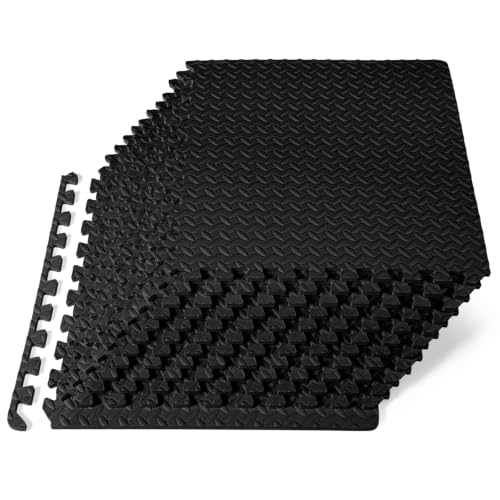
ProsourceFit Exercise Puzzle Mat, half inch EVA Foam Tiles
Cheap, warm underfoot and easy to cut around a rack base. Foam is for bodyweight work and dumbbells only. It compresses permanently under rack feet and it will not protect a slab from a dropped barbell.
Best for: A dumbbell and bodyweight corner, or an underlayer beneath rubber.
Check pricePrices change often, confirm on Amazon. As an Amazon Associate we earn from qualifying purchases.
Running total: $119.99 rack, $99.99 bar, $159.99 plates, $149.99 bench, $119.99 for one rubber stall mat under the rack and drop zone, $49.99 of foam tiles for the rest of the floor. That is $699.94. Add $32.99 of wedge anchors and $10.99 of collars and the build lands at $743.92.
What you are giving up: 110 lb of iron runs out fast, so plan to add plates within a few months, and iron on a slab is loud and unforgiving of a missed rep. The CAP rack is light gauge steel with a modest rating, so bolt it down and keep the loads sensible. Foam compresses permanently under rack feet, which is why the stall mat goes under the rack and the foam goes everywhere else.
The under $1,400 mainstream build
This is the build most people should copy. It is the point where nothing in the gym is the limiting factor for years, and where every piece is something you keep rather than replace.
The under $1,400 mainstream build

REP PR-1100 Power Rack
Rated to 700 lb, 1 inch hole spacing, and an accessory ecosystem that still fits years later. At roughly 84 inches tall it is the rack most basements can just barely take, which is why it shows up in so many low ceiling builds.
Best for: The build you expect to keep and add to rather than replace.
Check price
Synergee Regional 20 kg Barbell, Hard Chrome
Needle bearings, 190,000 PSI tensile strength, dual knurl marks and a 1,500 lb rating. Hard chrome resists the humidity swing that eats bare steel bars in a garage, which is the single most useful thing a bar can do outside a climate controlled room.
Best for: One bar that handles squats, presses and cleans without complaint.
Check price
CAP 260 lb Economy Olympic Bumper Plate Weight Set
Pairs of 10, 15, 25, 35 and 45 with a steel insert hub. Rubber spreads a dropped deadlift across the whole plate face instead of a 2 inch iron edge, which is the entire argument for bumpers in a basement or over a wood subfloor.
Best for: Anyone lifting above a finished room or on a suspended floor.
Check price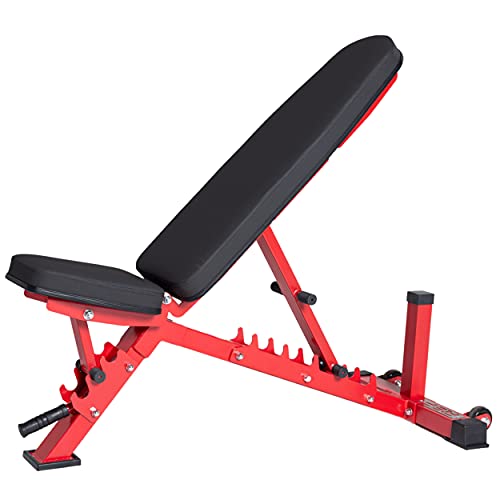
REP AB-3100 Adjustable Bench
A flat, incline and decline bench with a proper ladder frame, a firm pad and a folding footprint. The step up you feel is lateral stability under a heavy dumbbell press, which is where budget benches start to feel unnerving.
Best for: A bench that will still be in the gym after two rack upgrades.
Check price Heavy Duty Rubber Stall Mat, 4 by 6 ft, three quarter inch
The garage gym default for a reason. Three quarter inch recycled rubber at roughly 100 lb a mat absorbs a dropped bar, stays put by weight alone and outlasts the rack on top of it. Two mats cover a standard rack footprint.
Best for: Any platform, rack base or deadlift area over concrete.
Check price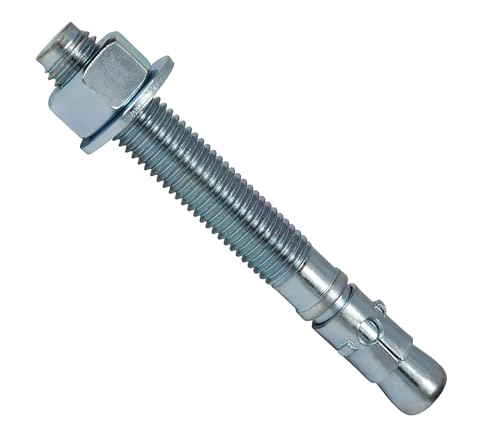
CONFAST half inch by 5.5 inch Wedge Anchors, Box of 25
Half inch wedge anchors are what most rack manufacturers specify for a concrete slab. Embedment depth, not bolt length, is what carries the load, so read the rack manual before you buy a length.
Check pricePrices change often, confirm on Amazon. As an Amazon Associate we earn from qualifying purchases.
Running total: $379.99 rack, $149.95 bar, $259.99 for a 260 lb bumper set, $269.99 bench, $239.98 for two rubber stall mats, $32.99 of wedge anchors and $10.99 of collars. $1,343.88 complete.
Three things change from the starter build and each is worth the money. The REP PR-1100 is rated to 700 lb with 1 inch hole spacing, which fixes the benching problem where 2 inch spacing leaves the J-cups either slightly too high or slightly too low. Bumpers instead of iron mean you can drop a deadlift, which matters enormously over a wood subfloor. And the AB-3100 stops the lateral wobble that makes heavy dumbbell pressing on a budget bench feel unnerving.
Two stall mats cover 48 square feet, which is a standard rack footprint plus a lifting area. Run your own room through the flooring square footage calculator if your layout is unusual.
The under $2,000 build
At this level you are not buying more capability, you are buying permanence and quality of life. The plates, bench and flooring carry over from the mainstream build unchanged, because there is nothing wrong with them. What changes is the rack, the bar, and the accessories that make the room work.
What changes in the under $2,000 build

Body-Solid GPR378 Power Rack
Heavy gauge tube, light commercial construction and a lifetime frame warranty. It is heavier, deeper and more permanent than the tier below, which is exactly the point once you are squatting and benching serious weight alone.
Best for: Lifters loading past 400 lb who want a rack rated well beyond what they lift.
Check price
Synergee Games 20 kg Ceramic Coated Barbell
The same 1,500 lb rated bar under a ceramic coating that shrugs off chalk, sweat and the condensation cycle in an unheated garage. Rust prevention you do not have to remember to do is worth more than another needle bearing.
Best for: Unheated garages and anyone who has already replaced one rusted bar.
Check price
Titan Fitness Wall Mounted Weight Plate Storage Rack, 4 Peg, 800 lb
Plates on the wall free up the square footage you actually lift in, and they keep iron off a floor you are trying to protect. It is a wall-anchored load, so the pegs are only as good as what they are lagged into.
Check price
iLIVING 20 inch Floor and Wall Mount Fan, 5,750 CFM
Air movement is the cheapest thing you can do about a hot garage, and moving humid air is also what keeps condensation off a cold bar. Wall mounting it keeps the blade out of the barbell drop zone.
Check price
MIUONO Landmine Attachment for 2 inch Olympic Bars
A landmine press travels forward and up on an arc instead of straight overhead, so it fits under a 7 foot ceiling that would stop a strict barbell press dead. Twenty dollars solves the most common low ceiling complaint.
Check pricePrices change often, confirm on Amazon. As an Amazon Associate we earn from qualifying purchases.
Running total: $599.00 for the Body-Solid GPR378, $169.95 for the ceramic coated Synergee Games bar, $259.99 for the same 260 lb bumper set, $269.99 for the same AB-3100 bench, $359.97 for three stall mats, $32.99 of anchors, $10.99 of collars, $74.97 of wall plate storage, $51.85 for a wall mount fan and $21.99 for a landmine attachment. $1,851.69 complete, leaving about $148 of headroom under $2,000.
The GPR378 buys heavy gauge tube, light commercial construction and a lifetime frame warranty, which is the right call once you are squatting and benching serious weight with nobody in the house. The ceramic coated bar buys rust resistance you do not have to remember to maintain, which is worth more in an unheated garage than another set of bearings. The plate storage gets 300 lb of iron off the floor you are trying to lift on, and the fan is the cheapest real fix for a hot garage.
What do the three builds actually cost, line by line?
| Category | Under $800 | Under $1,400 | Under $2,000 |
|---|---|---|---|
| Rack | $119.99 | $379.99 | $599.00 |
| Barbell | $99.99 | $149.95 | $169.95 |
| Plates | $159.99 | $259.99 | $259.99 |
| Bench | $149.99 | $269.99 | $269.99 |
| Flooring | $169.98 | $239.98 | $359.97 |
| Anchors and collars | $43.98 | $43.98 | $43.98 |
| Storage, fan, landmine | $0.00 | $0.00 | $148.81 |
| Total | $743.92 | $1,343.88 | $1,851.69 |
Check those against the target split and you can see where real builds deviate. In the mainstream build the rack is 28 percent, plates 19 percent, bar 11 percent, bench 20 percent and flooring 18 percent, which is close to the model. In the top build flooring climbs to 19 percent because a third mat is cheap and plates fall to 14 percent because bumpers cost more per pound than iron. Both are fine. What is not fine is a build where flooring is zero.
What breaks if you skip flooring or buy the rack last?
Skipping flooring costs you three ways. Rack feet concentrate load on four small contact points, which punches into a bare slab and craters a wood subfloor. Dropped iron chips concrete and cracks the plates themselves, and a $260 plate set outlasts a $120 mat many times over. And impact noise is structure-borne, meaning it travels through the floor into the rest of the house rather than through the air, so rubber mass under the drop zone does more than any amount of insulation. Flooring is the cheapest insurance in the entire build.
Buying the rack last costs you fit. Every other purchase has to work with the rack: the bench has to fit between the uprights and slide far enough forward that the bar sits over your chest, the flooring layout depends on a known footprint, the plate storage goes where the rack is not. People who buy a bench first routinely discover its rear foot is too wide for the cage they later choose, and that is a bench you replace rather than a bench you adjust. Buy the rack, then buy around it. Our home gym cost calculator lets you price your own version of any of these builds.
Who should not buy the Expert tier?
A lot of people should not build the $1,851.69 version, and the reason is that its advantages are specific rather than general. If you squat under about 315 lb and bench under about 225 lb, train in a garage bay that also holds a car, and are still in your first two years of serious lifting, the Body-Solid GPR378 at $599.00 is $219 spent on a rating you are not approaching and a frame depth that costs you floor space. The PR-1100 at $379.99 is rated to 700 lb, which is already more than double what you are loading.
The ceramic bar is the same story. In a climate controlled basement, the $149.95 hard chrome Synergee Regional is the correct answer and the $20 upgrade buys rust protection you do not need. Ceramic earns its money in an unheated garage where the bar goes through a condensation cycle every spring and autumn.
And if your total budget is genuinely under about $800, do not stretch. Build the starter gym at $743.92, train on it for a year, and put the money you would have spent on a nicer rack into more plates instead. A 110 lb iron set runs out long before a $119.99 rack does, and adding load changes your training in a way that a heavier upright never will.
Related reading
- Home gym buying order: what to buy first, second and last
- Best power rack: the piece that sets every other dimension
- Home gym vs gym membership cost: when these builds pay for themselves
- All gear reviews
Frequently asked questions
Can you build a real home gym for under $2,000?
Yes, and with room to spare. A rack, bar, plates, bench, flooring and anchoring hardware built around the Body-Solid GPR378 comes to about $1,851.69 including plate storage, a fan and a landmine attachment. A perfectly good version built on the REP PR-1100 comes to about $1,343.88, and a functional starter build lands near $743.92. Above $2,000 you are buying specialty equipment, not capability.
What is the minimum you can spend on a barbell home gym?
About $750 for something that actually works. A CAP power rack at $119.99, a CAP 7 foot Olympic barbell at $99.99, a 110 lb iron plate set at $159.99, a FLYBIRD WB5 bench at $149.99, one rubber stall mat at $119.99 and foam tiles at $49.99 comes to $699.94, plus $32.99 of wedge anchors and $10.99 of collars. Everything in it is a real Olympic-standard piece you can keep.
How should I split a home gym budget?
Roughly 30 percent to the rack, 20 percent to plates, 12 percent to the bar, 15 percent to the bench, 15 percent to flooring, and the remainder to anchoring hardware, collars and accessories. The rack takes the largest share because it is the piece you will not replace and the piece that keeps you safe alone. Plates come second because load is what drives progress.
Should I buy the rack first or last?
First, and it is not close. Every other purchase in the build has to fit inside or around the rack: the bench must fit between the uprights, the flooring must sit under a known footprint, the plate storage bolts to it or beside it. Buying the rack last means measuring everything twice and discovering that the bench you already own does not slide far enough forward to press safely.
What happens if I skip the flooring to save money?
Three things, and all of them cost more later. Rack feet punch into a bare slab or crater a wood subfloor, dropped iron chips concrete and cracks plates, and impact noise travels straight through the structure into the rest of the house. Flooring is the cheapest insurance in the build at about $120 per rubber stall mat, and two mats cover a standard rack footprint plus a lifting area.
Do I need bumper plates or will iron do?
Iron is fine on a slab with controlled lifts and it is far cheaper per pound, which is why the starter build uses a 110 lb iron set at $159.99. Bumpers become necessary the moment you drop the bar or lift above a finished room, because rubber spreads the impact across the whole plate face instead of a 2 inch iron edge. The 260 lb bumper set at $259.99 is the sensible upgrade.
How we choose: we compare published manufacturer specifications, stated load ratings, and verified owner reviews. We do not test equipment in person. Rack anchoring, floor loading and spotting carry real injury and property risk, so treat everything here as researched guidance rather than coaching or structural engineering advice, follow the manufacturer's rated capacity and installation instructions, and get a licensed professional involved before you drill into concrete or load a floor you are unsure about.