Best Adjustable Dumbbells in 2026
The BowFlex SelectTech 552 pair ($399.00) is the best adjustable dumbbell set for most home gyms: 5 to 52.5 lb per hand with 2.5 lb steps at the bottom of the range, in about the floor space of a shoebox each. The PowerBlock Sport 24 ($219.00) is the budget and small room pick.
Adjustable dumbbells are the highest value per square foot of anything you can put in a home gym. One pair replaces twenty pairs of fixed dumbbells and a 5 foot rack, and it does it in the space of two shoeboxes. For most builds the answer is the BowFlex SelectTech 552 pair at $399.00 , mostly because of the 2.5 lb increment at the bottom of its range rather than the 52.5 lb at the top.
An adjustable dumbbell is a handle plus a mechanism that picks up a selected number of plates and leaves the rest behind in a cradle. The mechanism is the product. Everything else follows from it.
Best adjustable dumbbells by experience level
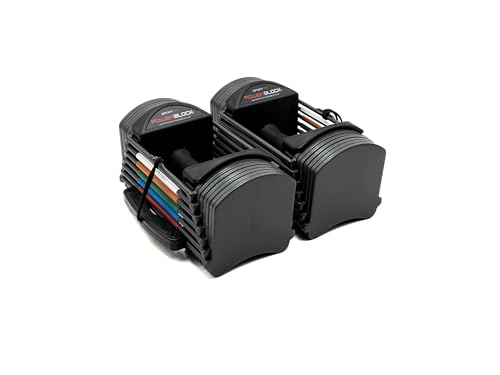
PowerBlock Sport 24 Adjustable Dumbbells, Pair
Three to 24 lb per hand in a steel cage the size of a shoebox. The block shape keeps the loaded footprint tiny, which matters far more in a 10 by 10 basement room than the top-end weight does.
Best for: Accessory work, small rooms, and anyone not yet pressing over 25 lb per hand.
Check price
BowFlex Results Series 552 SelectTech Dumbbells, Pair
5 to 52.5 lb per hand in 2.5 lb steps at the bottom of the range, which is the increment that actually lets pressing progress. The dial mechanism is faster than any plate-loaded design and the handle length stays constant.
Best for: The one dumbbell purchase most home gyms ever need.
Check price
PowerBlock Elite USA 90 lb Adjustable Dumbbells, Pair
5 to 90 lb per hand with selector pin plus add-on weights, in a footprint no larger than the 50 lb version. This is the tier that replaces an entire dumbbell rack rather than supplementing one.
Best for: Lifters already dumbbell pressing over 50 lb per hand.
Check pricePrices change often, confirm on Amazon. As an Amazon Associate we earn from qualifying purchases.
Why is the increment more important than the top weight?
Look at the bottom of the range, not the headline number. Progress on a press is limited by the smallest jump you can take, and at light weights those jumps are enormous in percentage terms. Moving from 20 lb to 25 lb per hand is a 25 percent increase, which nobody adds to an overhead press in one session. A set that only moves in 5 lb steps will park a new lifter at the same weight for a month.
The 552 uses 2.5 lb steps through the lower half of its range, which halves that jump and keeps the lift moving. At the top of the range 5 lb steps are perfectly fine, because 5 lb on top of 45 is about 11 percent rather than 25. This is the single most useful spec in the category and it is almost never the one on the front of the box.
The same logic explains why the PowerBlock Sport 24 at $219.00 is a genuinely good buy despite topping out at 24 lb per hand. If you are not yet pressing 25 lb per hand, its range is not the limitation, and 3 lb increments at the bottom are excellent.
| Set | Price | Range per hand | Smallest step | Mechanism | Shape |
|---|---|---|---|---|---|
| PowerBlock Sport 24 | $219.00 | 3 to 24 lb | 3 lb | Selector pin | Block cage |
| BowFlex SelectTech 552 | $399.00 | 5 to 52.5 lb | 2.5 lb | Dial at each end | Traditional |
| PowerBlock Elite USA 90 | $869.00 | 5 to 90 lb | 5 lb | Selector pin plus add-ons | Block cage |
Dial, selector pin or plate loaded?
A dial mechanism uses a knob at each end to pick up a chosen number of plates from the cradle. It is the fastest of the three, taking a couple of seconds per end, and it is why the 552 gets used for drop sets and supersets where a slower design gets abandoned.
A selector pin runs through a stack of nested rectangular plates and is nearly as quick. PowerBlock builds this way, and the advantage is that add-on weights extend the range later without replacing the handle. The disadvantage is the shape, which is discussed below.
Plate loaded handles are the cheapest option and the one most likely to end up unused. Loading and unloading collars between every set adds enough friction that people quietly stop changing the weight, which defeats the point. If your budget only reaches plate loaded handles, the honest advice is to buy two pairs of fixed dumbbells instead.
How does handle length change as the weight changes?
This is the spec nobody checks and everybody notices. On a traditional adjustable dumbbell, the handle length between the plates stays constant while the plates themselves get wider outward, which means the loaded dumbbell grows longer as you add weight. At 50 lb per hand, a traditional adjustable is a noticeably long object, and it clips your thighs on a curl and your ribs on a press if you are not paying attention.
Block designs like PowerBlock take the opposite approach. The weight is added inside a rectangular cage around a fixed handle, so the outer dimensions barely change between the lightest and the heaviest setting. That is why the Elite USA 90 fits in the same footprint as the 50 lb version. The trade is that the cage sits close around your hand, which some people find confining and others stop noticing after a week.
Neither shape is better. It is a preference, and it is worth knowing before you order rather than after.
Length also creates the one genuine safety difference between the shapes, which is rack-out risk. A long traditional adjustable at 50 lb per hand has to clear your torso as you bring it from your thigh to your shoulder, and the usual failure is catching an end on the bench frame or on your own knee while you are setting up. That is a moment where a mechanism holding loose plates is being knocked sideways, which is exactly what it is worst at. Block designs are shorter end to end and are easier to bring into position, at the cost of a cage sitting closer to your hand. Whichever you buy, set up seated with the dumbbells on your thighs and kick them into position rather than curling them up, and leave the bench far enough from a wall that a long dumbbell cannot catch it.
How much floor space do they actually take?
Measure the cradle, not the dumbbell. The cradle is the thing that lives on your floor permanently, and a pair with cradles occupies roughly 4 to 6 square feet, or a sturdy shelf if you would rather get them off the ground entirely.
Compare that against the alternative. Covering 5 to 52.5 lb in fixed dumbbells at 5 lb steps is about twenty pairs, a rack roughly 5 feet wide and 2 feet deep, and several hundred pounds of iron on your floor. In a 10 by 12 foot basement room that rack is a meaningful share of the space you were going to lift in, which is why adjustables win so decisively in small rooms. Work the numbers for your own room with the gym space planner.
The block designs are the tightest of all. A PowerBlock at 24 lb is roughly the size of a shoebox, which is the reason it belongs in a small room even though its top weight is modest.
What do adjustable dumbbells cost per pound of capacity?
Cost per pound of capacity is the total price divided by the total weight both dumbbells can hold at once, and it is the only number that makes three very different products comparable. It is not a ranking on its own, because a pound you cannot lift is worth nothing, but it does show you where the money actually goes.
The 552 at $399.00 holds 52.5 lb per hand, so 105 lb across the pair, which works out near $3.80 per pound. The Sport 24 at $219.00 holds 48 lb across the pair, or about $4.56 per pound. The Elite USA 90 at $869.00 holds 180 lb across the pair, or about $4.83 per pound. The middle tier is the cheapest per pound as well as the most useful, which is unusual in this niche and is a large part of why it is the pick.
Now compare that against fixed dumbbells, which is where the case for adjustables is actually made. Covering 5 to 52.5 lb in 5 lb steps takes roughly twenty pairs and somewhere near 550 lb of iron. Fixed dumbbells commonly sell in the range of $1.50 to $2.50 per pound depending on style, finish and where you buy them, so that range costs somewhere around $825 to $1,375 before you add a rack to put them on. Per pound, fixed iron is cheaper. Per pound of range you can actually reach in a spare bedroom, it is not close.
Footprint is the other axis. A pair of adjustables with cradles takes roughly 4 to 6 square feet. Twenty pairs of fixed dumbbells on a rack take something like 10 square feet of floor and a wall run about 5 feet long. Same range, roughly double the committed floor, several hundred dollars more, and a rack you then have to work around. Run your own room through the gym space planner if you are close to the line.
| Option | Price | Capacity per hand | Pair capacity | Cost per lb | Floor committed | Lb per sq ft |
|---|---|---|---|---|---|---|
| PowerBlock Sport 24 | $219.00 | 3 to 24 lb | 48 lb | $4.56 | ~3 sq ft | ~16 |
| BowFlex SelectTech 552 | $399.00 | 5 to 52.5 lb | 105 lb | $3.80 | ~4 sq ft | ~26 |
| PowerBlock Elite USA 90 | $869.00 | 5 to 90 lb | 180 lb | $4.83 | ~4 sq ft | ~45 |
| Fixed pairs, 5 to 52.5 lb | $825 to $1,375 | 52.5 lb | ~550 lb | $1.50 to $2.50 | ~10 sq ft plus rack | ~55 |
What actually breaks on an adjustable dumbbell?
Every adjustable design is a handle, a set of loose plates and a mechanism that decides which plates come with you, so every failure mode traces back to that mechanism. Based on published specifications and verified owner reviews, the same handful of problems come up across brands and price points.
A partially engaged selection is the one that matters. If the dial is not fully seated in a detent, or the pin is not through the block cleanly, the handle can lift with a plate that is not properly captured. That plate then comes off somewhere between the cradle and your shoulder. The habit that prevents it costs nothing: turn the dial to a click you can feel at both ends, then lift the dumbbell an inch clear of the cradle and pause before you commit to it.
Drops are the expensive one. A dropped adjustable can crack a plate, bend a selector pin or jam a dial, and on most designs the repair is not a spare part, it is the unit. That is a genuine limitation of the category rather than a knock on any one brand.
Grit and chalk in the mechanism is the slow one. Dial and pin mechanisms are tolerance-dependent, and chalk dust plus garage grit gradually turns a smooth change into a fight. Blowing the mechanism out occasionally and keeping the cradles off a dusty slab, which is another argument for foam tiles under the storage area, handles most of it.
| Failure | Design most affected | Usual cause | Warning sign | Practical outcome |
|---|---|---|---|---|
| Plate released mid-rep | Dial | Selection not fully seated | Dial stops between clicks | Injury risk, check every lift |
| Cracked plate | All | Dropped from shoulder height | Visible chip or rattle | Usually replace the unit |
| Bent selector pin | Selector pin | Dropped or twisted under load | Pin no longer slides freely | Sometimes a spare part |
| Jammed dial | Dial | Impact or grit in the mechanism | Stiff or gritty rotation | Clean first, then replace |
| Cracked plastic housing | Traditional dial | Set down hard on a hard floor | Flex or creak in the shell | Cosmetic at first, then structural |
| Worn cradle | All | Years of loading and unloading | Plates no longer align | Cheapest failure of the set |
What do you need alongside a pair of adjustable dumbbells?
Three things, and all of them are cheap next to the dumbbells themselves.
A bench. Dumbbells without a bench cover roughly half the useful movements. A FLYBIRD folding flat bench at $75.99 is rated to 600 lb and stands upright against a wall, which is the right answer in a room where nothing can stay set up. If the room is permanent, the REP AB-3100 at $269.99 adds incline and the lateral stability that stops a heavy dumbbell press feeling unnerving. There is more in our bench guide.
Something under the cradles. A loaded cradle is a concentrated static load on whatever it sits on, and setting a 50 lb dumbbell down on a hard floor over and over is how the housings crack. A rubber stall mat at $119.99 under the working area handles both problems, and the flooring guide covers what belongs where.
A pulling option. Dumbbells press and row well and pull vertically not at all. A doorway pull-up bar at $27.99 or a suspension trainer at $29.99 closes that gap for the price of a couple of takeaways, and neither takes any floor space at all.
Where is the honest crossover point with fixed dumbbells?
Fixed dumbbells win in four situations, and they are worth naming because the adjustable category tends to pretend they do not exist.
- Two people training together. One adjustable pair cannot serve two lifters who need different weights in the same superset.
- You only need two or three weights. A pair of fixed 30 lb dumbbells costs a fraction of any adjustable set and never jams.
- You drop them. Fixed dumbbells tolerate abuse. Adjustables do not, and repairs are usually the whole unit.
- Fast circuits. Even a two second adjustment is too slow when the whole point is not stopping.
Outside those cases, adjustables are the better buy for a home gym almost every time. The full comparison is in adjustable vs fixed dumbbells.
Who should not buy the Expert tier?
Skip the PowerBlock Elite USA 90 at $869.00 unless you are already dumbbell pressing over 50 lb per hand. That is not a soft guideline, it is the entire justification for the price. The Elite range above 52.5 lb is the only thing it offers over the 552 at $399.00 , and a lifter who tops out at 40 lb per hand is spending $470 on weight they will not touch for years, if ever.
A lifter benching 185 lb with a barbell, dumbbell pressing 45 lb per hand, building a gym in a spare bedroom on a $2,500 total budget, should buy the 552 and put the difference toward a bench or a rack, which are the items actually limiting the program. And a beginner pressing 20 lb per hand in a 10 by 10 basement corner should buy the Sport 24 at $219.00 without embarrassment, then upgrade in two years having spent $219 rather than $869 to find out what they actually need. Buying dumbbell weight you cannot lift is the most common overspend in a first home gym.
Related reading
- Best bench: the other half of a dumbbell program
- Best home gym for small spaces: the whole build at minimum footprint
- Home gym buying order: where dumbbells sit in the sequence
- Intermediate home gym setup: the build dumbbells usually join
- One rep max percentage chart: picking working weights once the increments matter
Frequently asked questions
What are the best adjustable dumbbells for a home gym?
The BowFlex SelectTech 552 pair at $399.00 is the best choice for most home gyms. It covers 5 to 52.5 lb per hand and uses 2.5 lb steps at the bottom of the range, which is the increment that lets a press actually progress. The PowerBlock Sport 24 at $219.00 is the small room and small budget answer, and the PowerBlock Elite USA 90 at $869.00 replaces a whole rack.
Why does the increment at the bottom of the range matter so much?
Pressing progress is limited by the smallest jump you can make. Going from 20 to 25 lb per hand is a 25 percent increase, which is a huge leap on an overhead press, and a pair that only moves in 5 lb steps stalls a beginner for weeks. A 2.5 lb step at the bottom halves that jump and keeps the lift moving. At the top of the range 5 lb steps are fine, because they are a much smaller percentage.
Dial, selector pin or plate loaded, which mechanism is better?
A dial mechanism changes weight in a couple of seconds by turning a knob at each end, which is the fastest and the reason dial designs dominate. A selector pin moves through a stack of nested plates and is nearly as quick, with add-on weights extending the range. Plate loaded handles are the cheapest and the slowest, and swapping plates between sets is enough friction that most people stop training the way they intended.
Can you drop adjustable dumbbells?
No, and this is the honest limitation of the entire category. Every adjustable design relies on a mechanism holding loose plates to a handle, and dropping one from shoulder height can crack a plate, bend a selector or jam the dial. Set them down under control every rep, which also means you should not take a heavy dumbbell press to failure alone. Fixed dumbbells tolerate abuse in a way these do not.
How much space do adjustable dumbbells take up?
A pair with cradles occupies roughly 4 to 6 square feet of floor, or a shelf, which is why they are the highest value per square foot in a home gym. The equivalent fixed dumbbell range from 5 to 52.5 lb is around twenty pairs and a rack about 5 feet wide. Measure the cradle, not the dumbbell, because the cradle is what actually sits on your floor permanently.
When are fixed dumbbells the better buy?
When you train with two people, when you superset across weights and cannot wait for adjustments, or when you only need two or three specific weights. A pair of fixed 30 lb dumbbells costs far less than any adjustable set and never jams. Fixed also wins for anyone dropping them, doing dumbbell work in a commercial setting, or building a gym where two lifters need the same weight at once.
How we choose: we compare published manufacturer specifications, stated load ratings, and verified owner reviews. We do not test equipment in person. Rack anchoring, floor loading and spotting carry real injury and property risk, so treat everything here as researched guidance rather than coaching or structural engineering advice, follow the manufacturer's rated capacity and installation instructions, and get a licensed professional involved before you drill into concrete or load a floor you are unsure about.