Best Weight Bench for a Home Gym: 3 Picks Compared
The REP AB-3100 ($269.99) is the best weight bench for most home gyms, giving you flat, incline and decline on a ladder frame with a firm pad and the lateral stability that budget benches lack under a heavy dumbbell press. The FLYBIRD WB5 ($149.99) is ASTM certified to 800 lb and folds upright if the bench has to disappear between sessions.
A bench is the piece of equipment people underbuy and then replace, because the thing that separates a $150 bench from a $270 one is invisible on a spec sheet: lateral stability under a heavy dumbbell press. The REP AB-3100 at $269.99 is where that wobble stops being something you notice.
Below are three benches at genuinely different price points, plus the specs that actually decide which one is right: rated capacity and what certification means, the pad gap, pad width and firmness, the adjustment mechanism, and whether the bench physically fits the rack you already own. There is also a list of specs the box shouts about that should not move your decision at all.
Best adjustable weight benches by experience level

FLYBIRD WB5 Adjustable Weight Bench
ASTM certified to 800 lb, folds upright for storage and arrives essentially assembled. The ladder adjustment is slower than a pop-pin and the pad is narrow, but for dumbbell work and light pressing it does the job.
Best for: Dumbbell work in a room where the bench has to disappear afterwards.
Check price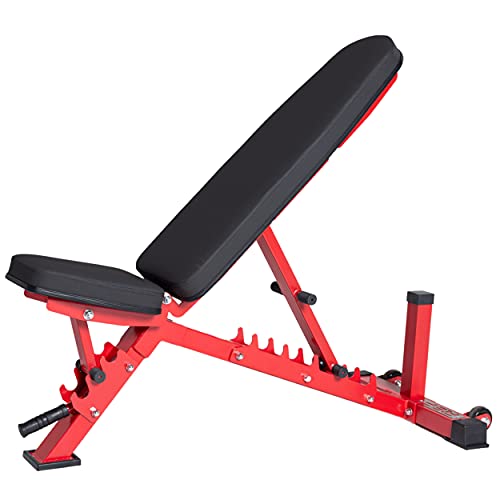
REP AB-3100 Adjustable Bench
A flat, incline and decline bench with a proper ladder frame, a firm pad and a folding footprint. The step up you feel is lateral stability under a heavy dumbbell press, which is where budget benches start to feel unnerving.
Best for: A bench that will still be in the gym after two rack upgrades.
Check price
REP Nighthawk Adjustable Weight Bench
A heavier frame, a wider high density pad and a pad gap small enough that it stops being something you think about. This is a comfort and confidence purchase, not a capability one.
Best for: Heavy benching, or anyone who has outgrown a folding bench flexing under them.
Check pricePrices change often, confirm on Amazon. As an Amazon Associate we earn from qualifying purchases.
What does a bench capacity rating actually promise?
Rated capacity is the combined weight of the lifter plus the load the manufacturer tested the bench to hold under a defined static condition. It is not a rating for a dropped dumbbell, an off-center load, or someone stepping onto one end of the pad.
That distinction is why certification matters more than the headline number. ASTM certification, which the FLYBIRD WB5 carries at 800 lb, means the bench was tested against a published procedure rather than a figure someone picked. An uncertified 1,000 lb claim and a certified 800 lb claim are not the same kind of statement, and the certified one is the better bench.
Do the arithmetic on your own numbers, because it is more reassuring than the marketing. A 200 lb lifter pressing 100 lb dumbbells loads the bench to 400 lb, exactly half of an 800 lb rating. The same lifter benching 315 lb in a rack is at 515 lb, which is 64 percent of the rating. Add a 75 lb spouse sitting on the end to hand you a dumbbell and you are at 590 lb, still inside it.
The practical conclusion is that rated capacity is almost never the thing that fails on a home gym bench. Frame stiffness is. A bench can be nowhere near its rating and still flex laterally enough to feel like it is trying to tip you, which is a stability problem rather than a strength one, and no capacity number on a box describes it.
What is the pad gap and why does it matter?
The pad gap is the horizontal space between the back pad and the seat pad on a two-piece adjustable bench. It exists because the two pads have to move independently when you change the incline angle.
On a flat setting that gap lands somewhere between your upper back and your tailbone depending on the bench geometry and your height. Around 2 to 3 inches is the range most lifters stop noticing. Push past about 4 inches and it becomes a pressure point on a heavy set, which is the single worst time to be distracted by furniture. The REP Nighthawk at $449.99 charges a premium largely for closing that gap, which is a comfort and confidence purchase rather than a capability one.
A single-piece flat bench has no gap at all, which is one honest argument for owning a dedicated flat bench alongside an adjustable one if you compete in powerlifting. A folding flat bench at $75.99 is cheap enough that keeping both is a realistic option in a garage, though not in a room where storage is the binding constraint.
How wide and how firm should a bench pad be?
Pad width is a tradeoff, not a bigger-is-better spec. Around 10 inches is the competition reference and it suits narrow-shouldered lifters and anyone who wants free shoulder blade movement on a bench press. Around 12 inches supports a broad back better and is more comfortable for dumbbell work, but it starts interfering with shoulder retraction if you are not broad-shouldered. There is no correct answer, only a correct answer for your build.
Firmness matters more than width, and it is easier to judge. A soft pad compresses under load, and every fraction of an inch it sinks is range of motion and stability you lose at the bottom of a press. High density foam that feels almost unfriendly when you first sit on it is the correct choice. Press a thumb into a pad and if it sinks more than about a quarter of an inch under moderate pressure, that pad will sink considerably more under a loaded torso.
This is the clearest difference between the budget tier and the mainstream tier, and it explains a common complaint: a narrow soft pad reads as perfectly fine for dumbbell curls and unnerving under a heavy press. The bench did not change. The load did.
Ladder adjustment or pop-pin: which should you buy?
A ladder bench uses a bracket under the back pad that drops into notches on a fixed frame. A pop-pin bench uses a spring-loaded pin through a hole in a support arm. The ladder puts the load on metal resting on metal, the pop-pin puts a pin in shear.
Both are safe on a well built bench, so choose on workflow. The pop-pin changes angle in about two seconds without lifting the pad, which is worth real money if you superset incline and flat pressing. The ladder is cheaper to build well, which is why it shows up on benches that spend their budget on frame stiffness instead. Both the FLYBIRD WB5 and the REP AB-3100 use ladder adjustment, and the AB-3100 is the one that feels planted.
One real failure mode belongs to ladders specifically: a bracket that is not fully seated in its notch can slip under load. It is a two second visual check and it costs nothing, but it is a habit worth building on day one rather than after the first time it moves.
How do I know a bench will fit my power rack?
A bench and a rack are a dimensional system, not two separate purchases. Three measurements decide whether they work together, and getting any one of them wrong turns a good bench into a bench you resell.
Inside width between uprights. Measure the clear opening of your rack, then measure the widest point of the bench at floor level, which is usually the rear foot rather than the pad. A bench that is an inch too wide does not go in at all, and there is no adjustment that fixes it.
How far forward the bench can slide. A wide rear tripod foot often stops the bench before the pad reaches the bar path, which leaves you pressing over your face rather than your chest. That is a safety problem, not an ergonomics one, and it is the reason to check this before the rack ships rather than after.
Pad height against the rack hole zone. Competition bench height is 42 to 45 cm, roughly 16.5 to 17.7 inches, and most home benches land between 17 and 18 inches. Work the arithmetic: with a 17.5 inch pad, a lifter's locked-out bar position sits roughly 17.5 inches plus chest depth plus arm length above the floor, and the J-cup needs to hold the bar about 1 to 2 inches below that so you can unrack by sliding back rather than pressing up first.
With 2 inch hole spacing you can land up to 1 inch away from that ideal in either direction. With 1 inch spacing the worst case halves to half an inch. One hole at 2 inch spacing is the difference between unracking comfortably and having to press a heavy bar up 2 inches with no leverage before you can move it back. That is exactly why racks like the REP PR-1100 tighten hole spacing to 1 inch through the bench zone, and our rack upright hole spacing chart lists what common racks use.
| Bench | Price | Rated capacity | Positions | Adjustment | Folds |
|---|---|---|---|---|---|
| FLYBIRD WB5 | $149.99 | 800 lb, ASTM | Flat and incline | Ladder | Yes, upright |
| REP AB-3100 | $269.99 | Manufacturer rated | Flat, incline, decline | Ladder | Yes |
| REP Nighthawk | $449.99 | Manufacturer rated | Flat, incline, decline | Ladder | No |
| FLYBIRD folding flat bench | $75.99 | 600 lb | Flat only | None | Yes, stands upright |
What should you measure before you order a bench?
Five numbers, all of which you can take with a tape measure in about four minutes. Take them before you buy rather than after the box arrives, because a bench that does not fit is a return shipping problem on a 60 lb item.
| Measure this | Where | Typical figure | What goes wrong if you skip it |
|---|---|---|---|
| Rack inside width | Clear gap between uprights at floor level | Varies by rack | Bench physically will not enter the cage |
| Bench widest point | Rear foot, not the pad | 14 to 18 in | Bench jams on an upright halfway in |
| Pad height | Floor to top of pad, flat setting | 17 to 18 in | J-cups land a full hole away from your unrack height |
| Rack hole spacing | Center to center in the bench zone | 1 or 2 in | You press the bar up before you can unrack it |
| Working floor area | Around the whole bench station | About 48 sq ft | No room to bail out of a failed dumbbell press |
That last row is the one people forget. A bench is 48 to 52 inches long, you need about 24 inches of clearance beyond the head end to load and strip the bar, and about 30 inches of clear floor on each side to set up and bail out of a heavy dumbbell press. That is a working footprint near 8 feet by 6 feet, or roughly 48 square feet, which in a 10 by 12 foot room is 40 percent of the floor. Our home gym layout guide works the same problem for the whole room.
Specs that do not matter as much as the box implies
The headline capacity number. A 1,500 lb uncertified rating tells you nothing that an 800 lb ASTM rating does not tell you better. You are not going to load a home bench past about 600 lb combined, and the failure people actually experience is lateral flex well below the rating.
The number of back pad positions. Twelve positions sounds better than seven and is not. In practice you use flat, about 30 degrees, about 45 degrees and upright, and everything else is a position you set once and never return to. What matters is whether the bench has a true flat and a true 90 degree upright, because some benches with impressive position counts have neither.
Decline. Most home lifters use decline pressing almost never, and a decline setting frequently requires a leg roller assembly that adds bulk to storage. It is a nice inclusion rather than a reason to choose one bench over another.
Wheels and a transport handle. Genuinely useful in a garage that also holds a car, and irrelevant in a dedicated room where the bench never moves. Do not pay for it in a room with a fixed layout.
Upholstery material and color. Vinyl versus faux leather changes how sweaty your back gets and nothing else. Firmness underneath the covering is the spec that matters, and the covering is what the photos are selling.
What does matter: frame stiffness under lateral load, pad firmness, pad gap, pad height against your rack, and whether the rear foot lets the bench slide far enough forward. None of those five appear on a typical product page, which is why this category rewards measuring over reading.
What actually goes wrong, and what it costs to fix
The bench flexes under a heavy dumbbell press. The most common real complaint, and the most expensive because there is no fix. You cannot stiffen a frame that was not built stiff. The repair is a new bench, so a $149.99 bench that fails this way costs you $269.99 more to resolve, or about $345 net if you resell the first one for roughly half.
The rear foot stops the bench short of the bar path. Discovered on the first bench press session, not in the reviews. The workaround is pressing with the bar over your face, which is not a workaround. Cost to fix: a new bench, or a new rack, whichever is cheaper, and that is a $270 to $600 mistake caused by a measurement you could have taken in 30 seconds.
The pad tears at a seam. Usually where the pad meets the frame bracket, usually from sliding the bench across a rough concrete floor rather than lifting it. Cost to fix: a replacement pad if the manufacturer sells one, or a new bench if not. The prevention is a rubber stall mat under the bench, which also protects the slab.
Benching alone with nothing to catch the bar. The failure mode with the highest cost and the lowest fix cost. A set of spotter arms at $55.99 or correctly set safeties in a cage turns a failed rep into a shrug. Check your upright tube size and whether your holes are 5/8 inch or 1 inch before ordering, because arms that almost fit do not fit.
Buying tips
- Measure the rack before you shop for the bench. Inside width, hole spacing and the height of the lowest hole in the bench zone. Five minutes here prevents the most expensive mistake in the category.
- Buy firmness over width. A firm 10 inch pad beats a soft 12 inch pad for every lift, and you cannot add firmness later.
- Do not buy decline you will not use. Spend the same money on frame quality instead, or on adjustable dumbbells that give you more exercises than a decline setting ever will.
- Order spotter arms at the same time as the bench. They are $55.99, they are rack specific, and the session where you need them is not the session to discover you do not own them.
- Put the bench on rubber. A 3/4 inch stall mat stops the feet marking a slab, stops the bench sliding mid-set, and keeps the pad off a floor that tears seams.
Who should not buy the Expert tier?
Most people reading this should not buy the REP Nighthawk at $449.99, and the reason is specific. If you bench under about 225 lb, dumbbell press under about 60 lb per hand, and your bench has to fold and stand against a wall between sessions because the room is also a garage or a spare bedroom, the Nighthawk is $180 spent on a pad gap and a frame weight you will not use. It does not fold, which is a real cost in a shared space and not a spec you can work around.
Buy the AB-3100 instead in that case. And if you are building your first gym on a total budget under about $800, buy the FLYBIRD WB5 at $149.99 and put the $120 you saved into plates, because load is what drives progress and a nicer pad is not. A 110 lb plate set plus a 44 lb bar tops out at 154 lb on the bar, and running out of weight stops your training in a way that a slightly flexible bench does not.
The bench upgrade is also the easiest one to make later. A good bench sells used, it does not have to match anything you already own except the rack opening, and it ships without freight. If you genuinely do not know yet whether you will be pressing 60 lb or 100 lb dumbbells in two years, buying the cheaper bench now and upgrading later costs roughly $75 net after resale. That is cheap optionality, and it is a better use of uncertainty than buying the most expensive option and hoping.
Related reading
- Best power rack: the piece the bench has to fit inside
- How to choose a power rack: hole spacing, tube size and inside width
- Best adjustable dumbbells: what most people actually press on a bench
- Best home gym under $2,000: where the bench sits in a complete build
- All gear reviews
Frequently asked questions
What is the best adjustable weight bench for a home gym?
For most home gyms the REP AB-3100 at $269.99 is the right answer. It gives you flat, incline and decline on a ladder frame, a firm pad that does not sink under a heavy press, and enough lateral stability that a 70 lb dumbbell in each hand does not make the frame feel loose. On a tight budget the FLYBIRD WB5 at $149.99 is ASTM certified to 800 lb and folds upright against a wall.
What does a bench weight capacity rating actually mean?
A stated capacity is normally the combined weight of the lifter plus the load, tested by the manufacturer under a defined static condition. It is not a promise about a dynamic drop or an off-center load. ASTM certification means the bench was tested against a published standard rather than a number a marketing team chose, which is why an 800 lb ASTM rating is worth more than an uncertified 1,200 lb one.
How big should the pad gap on an adjustable bench be?
Smaller is better and about 2 to 3 inches is the point where most lifters stop noticing it. The gap is the space between the back pad and the seat pad on a two-piece adjustable bench, and it sits under your upper back or your tailbone depending on the angle. A gap past about 4 inches turns into a pressure point on a heavy set, which is exactly when you least want to be thinking about the bench.
Is a ladder adjustment or a pop-pin better on a bench?
A pop-pin is faster and a ladder is usually more stable and cheaper. Ladder benches use a bracket that drops into notches, so the load path is metal sitting on metal with no pin in shear. Pop-pins let you change angle in about two seconds without lifting the pad, which matters if you superset incline and flat. Neither is a safety issue on a well built bench, so treat it as convenience rather than capability.
Do I need a flat bench or an adjustable FID bench?
Buy adjustable unless space or budget forces your hand. A dedicated flat bench is stiffer, cheaper and usually lower, which suits a pure powerlifting bench press and stores in a closet. An adjustable FID bench adds incline pressing, seated shoulder work and supported rows, which is most of the accessory volume in a home program. The flat bench is correct only when the bench genuinely has to disappear between sessions.
Will any bench fit inside my power rack?
No, and this is the most common ordering mistake in a home gym build. Check three numbers before you buy: the inside width between your rack uprights, the widest point of the bench frame at floor level, and the pad height. The bench also has to slide far enough forward that the bar sits over your chest rather than your face, which a wide rear tripod foot often prevents entirely.
How much space does a bench station actually need?
Roughly 48 square feet of working area, which surprises people. The bench itself is about 48 to 52 inches long, then you need about 24 inches of clearance beyond the head end to load and unload the bar, and about 30 inches of clear floor on each side to set up and bail out of a heavy dumbbell press. That works out to a footprint near 8 feet by 6 feet.
How we choose: we compare published manufacturer specifications, stated load ratings, and verified owner reviews. We do not test equipment in person. Rack anchoring, floor loading and spotting carry real injury and property risk, so treat everything here as researched guidance rather than coaching or structural engineering advice, follow the manufacturer's rated capacity and installation instructions, and get a licensed professional involved before you drill into concrete or load a floor you are unsure about.